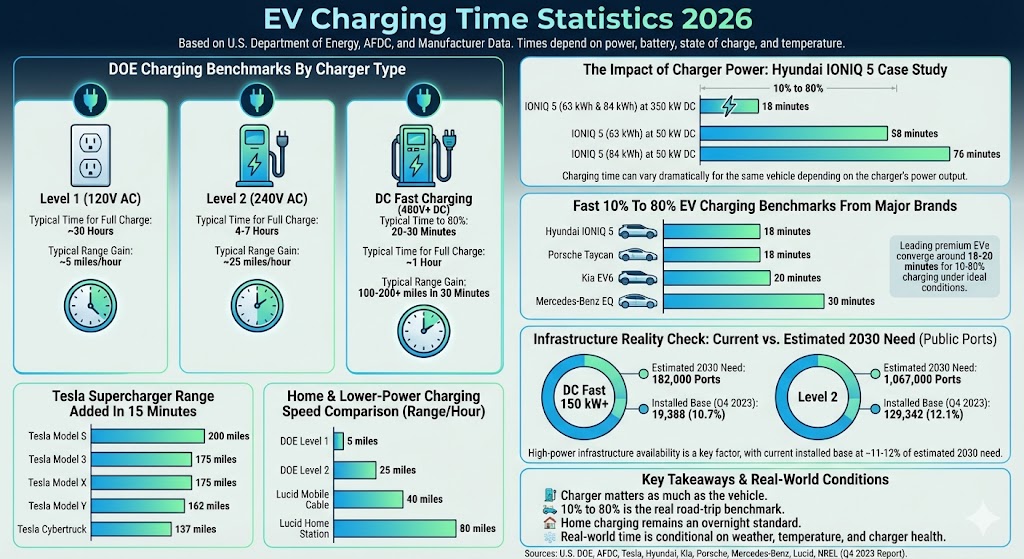
EV charging time still depends mainly on charger power, battery size, state of charge, and temperature. The U.S. Department of Energy says EV charging can range from less than 20 minutes on DC fast chargers to 20 hours or more on Level 1 charging, and its consumer guide gives a benchmark of about 30 hours for a full Level 1 charge, 4 to 7 hours for a full Level 2 charge, and 20 to 30 minutes for an 80% charge on DC fast equipment.
ev charging time statistics
That means the most useful EV charging time statistics are not just about a single number. They are about how much range different chargers add, how quickly leading EVs can move from 10% to 80%, and how much high-power infrastructure is actually available to deliver those headline charging times.
Key EV charging time statistics
Level 1 charging requires about 30 hours for a full EV charge in the DOE consumer benchmark.
Level 2 charging requires about 4 to 7 hours for a full charge in the same DOE benchmark.
DC fast charging typically reaches 80% in 20 to 30 minutes and a full charge in about 1 hour, according to DOE.
Level 1 adds about 5 miles of range per hour, while Level 2 adds about 25 miles per hour.
DC fast charging can add about 100 to 200+ miles in 30 minutes, according to AFDC.
DC fast chargers can deliver up to 500 kW, although AFDC notes many EVs currently on the road still cannot accept above 200 kW.
Tesla says Model S can add up to 200 miles in 15 minutes at a Supercharger.
Hyundai says the IONIQ 5 can charge from 10% to 80% in 18 minutes at a 350 kW DC charger.
Kia says the EV6 can charge from 10% to 80% in 20 minutes with DC fast charging.
Porsche lists 18 minutes for the Taycan to go from 10% to 80% at maximum DC charging power.
Mercedes-Benz says its EQ lineup can go from 10% to 80% in 30 minutes or less on Level 3/DC fast charging.
Lucid says its Connected Home Charging Station can add up to 80 miles of range per hour.
DOE charging benchmarks by charger type
The table below shows the most widely cited consumer charging benchmarks from DOE and AFDC. It is the clearest quick view of why EV charging time varies so much between a basic wall outlet and a high-power DC fast charger.
Charging option
Typical time benchmark
Typical range gain
Level 1
About 30 hours for a full charge
About 5 miles per hour
Level 2
About 4 to 7 hours for a full charge
About 25 miles per hour
DC fast charging
About 20 to 30 minutes to 80% and about 1 hour for a full charge
About 100 to 200+ miles in 30 minutes
Hyundai IONIQ 5 charging time changes sharply with charger power
One of the clearest charging-time comparisons comes from Hyundai. The same vehicle family can move from 18-minute 10% to 80% charging on a 350 kW charger to 58 or 76 minutes on a 50 kW charger, depending on battery size.
Label
Bar
Value
IONIQ 5 63 kWh at 350 kW DC
18 minutes
IONIQ 5 63 kWh at 50 kW DC
58 minutes
IONIQ 5 84 kWh at 350 kW DC
18 minutes
IONIQ 5 84 kWh at 50 kW DC
76 minutes
Max = 76. Widths: IONIQ 5 63 kWh at 350 kW DC 23.68%, IONIQ 5 63 kWh at 50 kW DC 76.32%, IONIQ 5 84 kWh at 350 kW DC 23.68%, IONIQ 5 84 kWh at 50 kW DC 100.00%.
Fast 10% to 80% EV charging benchmarks from major brands
Across mainstream premium EV brands, the best current 10% to 80% charging claims cluster tightly around 18 to 20 minutes for top 800-volt architectures. Mercedes-Benz is slower in this comparison, but still lists 30 minutes or less for 10% to 80% DC fast charging.
Label
Bar
Value
Hyundai IONIQ 5
18 minutes
Porsche Taycan
18 minutes
Kia EV6
20 minutes
Mercedes-Benz EQ
30 minutes
Max = 30. Widths: Hyundai IONIQ 5 60.00%, Porsche Taycan 60.00%, Kia EV6 66.67%, Mercedes-Benz EQ 100.00%.
Tesla Supercharger range added in 15 minutes
Tesla publishes model-specific Supercharging speed figures rather than a single fleet average. The spread is still tight enough to show how fast short charging stops can be on the network, with Model S topping the list at up to 200 miles in 15 minutes.
Label
Bar
Value
Tesla Model S
200 miles
Tesla Model 3
175 miles
Tesla Model X
175 miles
Tesla Model Y
162 miles
Tesla Cybertruck
137 miles
Max = 200. Widths: Tesla Model S 100.00%, Tesla Model 3 87.50%, Tesla Model X 87.50%, Tesla Model Y 81.00%, Tesla Cybertruck 68.50%.
Home and lower-power charging speed comparison
Fast public charging gets the headlines, but daily ownership still depends on home or lower-power charging. DOE lists 5 miles of range per hour for Level 1 and 25 miles per hour for Level 2, while Lucid says its own home charging products can reach 40 and 80 miles per hour.
Label
Bar
Value
DOE Level 1
5 miles per hour
DOE Level 2
25 miles per hour
Lucid Mobile Cable
40 miles per hour
Lucid Home Station
80 miles per hour
Max = 80. Widths: DOE Level 1 6.25%, DOE Level 2 31.25%, Lucid Mobile Cable 50.00%, Lucid Home Station 100.00%.
Fast-charging infrastructure still matters as much as vehicle specs
Paper charging times only matter when high-power chargers are available. The AFDC and NREL fourth-quarter 2023 infrastructure report counted 19,388 public DC fast charging ports rated at 150 kW or higher and 129,342 public Level 2 charging ports in the Station Locator. The same baseline scenario estimated the United States would need 182,000 public DC fast ports at 150 kW or higher and 1,067,000 public Level 2 ports by 2030, which put the installed base at 10.7% and 12.1% of those targets.
Infrastructure metric
Figure
Public DC fast ports rated 150 kW or higher
19,388
Public Level 2 ports
129,342
Estimated 2030 need for public DC fast ports rated 150 kW or higher
182,000
Estimated 2030 need for public Level 2 ports
1,067,000
Installed share of estimated 2030 DC fast need
10.7%
Installed share of estimated 2030 Level 2 need
12.1%
What these EV charging time statistics mean
The charger matters as much as the vehicle. Hyundai’s own numbers show the same IONIQ 5 can take 18 minutes or 76 minutes for 10% to 80% depending on charger power.
10% to 80% is the real road-trip benchmark. Tesla notes charging slows as the battery fills, which is why most fast-charging claims stop at 80%.
Leading fast-charge EVs are converging around 18 to 20 minutes. Hyundai, Porsche, and Kia all publish numbers in that range under ideal conditions.
Home charging is still measured in hours, not minutes. That is why overnight charging remains the standard ownership pattern even as public fast charging improves.
Real-world time remains conditional. Automakers and DOE all note that weather, battery temperature, state of charge, battery age, and charger capability can materially change actual charging time.
Sources
U.S. Department of Energy, How To Charge Electric Vehicles — https://www.energy.gov/energysaver/how-charge-electric-vehicles
Alternative Fuels Data Center, Electric Vehicle Charging Stations — https://afdc.energy.gov/fuels/electricity-stations
Tesla Support, Supercharging — https://www.tesla.com/support/charging/supercharging
Hyundai Motor Europe, Public Charging — https://www.hyundai.com/eu/en/electrification/owning-an-electric-vehicle/reasons-why/charging/public-charging.html
Hyundai Motor Europe, IONIQ 5 Performance — https://www.hyundai.com/eu/en/models/ioniq5/performance.html
AFDC and NREL, Electric Vehicle Charging Infrastructure Trends from the Alternative Fueling Station Locator: Fourth Quarter 2023 — https://afdc.energy.gov/files/u/publication/electric_vehicle_charging_infrastructure_trend