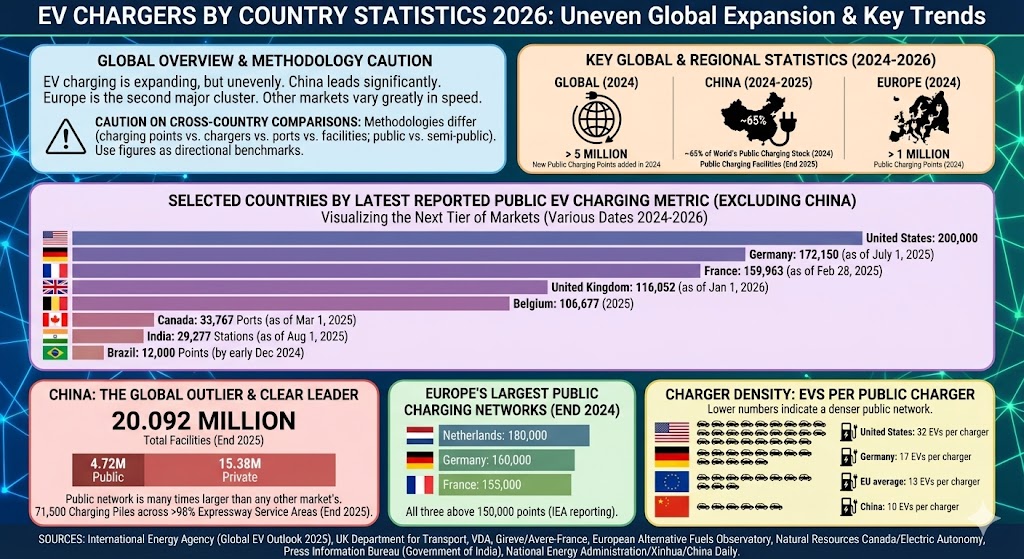
EV charging infrastructure is expanding quickly, but the country picture is uneven. China is now in a league of its own, Europe remains the second major charging cluster, and markets such as the United States, United Kingdom, India, Canada, and Brazil are still building out networks at very different speeds.
ev chargers by country statistics
The main caution with cross-country comparisons is methodology. Some national sources publish charging points, others publish chargers, ports, or total facilities, and some countries include semi-public access in headline figures. That means the numbers below are best used as directional benchmarks unless the same source and definition are being compared.
Key EV Chargers by Country Statistics
Global public EV chargers passed 5 million in 2024 after more than 1.3 million new public charging points were added during the year.
China accounted for about 65% of the world’s public charging stock in 2024.
By the end of 2025, China reported 4.72 million public charging facilities and 20.092 million total EV charging facilities.
Europe reached just over 1 million public charging points in 2024.
The Netherlands had Europe’s largest national charging network at the end of 2024 with more than 180,000 public charging points.
Germany had 172,150 publicly accessible charging points as of July 1, 2025, including 40,777 fast-charging points.
France had 159,963 publicly accessible charging points as of February 28, 2025.
The United Kingdom had 116,052 public EV chargers as of January 1, 2026.
Belgium counted 106,677 public and semi-public charging points in 2025.
Canada had 33,767 public charging ports across 12,955 public charging station locations as of March 1, 2025.
India had 29,277 public EV charging stations as of August 1, 2025, up from 25,202 at the end of 2024.
Brazil had over 12,000 public charging points by early December 2024.
Selected countries by latest reported public EV charging metric (excluding China)
China is excluded from the chart below because its public network is so much larger than every other market that it would flatten the rest of the bars. Among the next tier of countries, the United States, Germany, France, the United Kingdom, and Belgium all sit above the 100,000 mark on their latest reported national metrics, while Canada, India, and Brazil remain much smaller by absolute count.
Label
Bar
Value
United States
200,000
Germany
172,150
France
159,963
United Kingdom
116,052
Belgium
106,677
Canada
33,767
India
29,277
Brazil
12,000
Max = 200,000. Widths: United States 100.00%, Germany 86.08%, France 79.98%, United Kingdom 58.03%, Belgium 53.34%, Canada 16.88%, India 14.64%, Brazil 6.00%
China is still the clear global outlier
China remains far ahead of every other country. Official reporting tied to the National Energy Administration said the country reached 20.092 million total EV charging facilities by the end of 2025, including 4.72 million public facilities and 15.38 million private units. That public network alone is many times larger than the entire public network of any other national market in this article.
China’s buildout is also spreading beyond major coastal cities. By the end of 2025, the country had installed 71,500 charging piles across more than 98% of expressway service areas, underscoring that the national network is no longer just an urban convenience story.
Europe’s largest public charging networks at the end of 2024
Europe became the second major charging cluster after China, passing 1 million public charging points in 2024. The Netherlands, Germany, and France were the biggest national networks in Europe at year-end, and all three were already above 150,000 public charging points according to IEA reporting.
Label
Bar
Value
Netherlands
180,000
Germany
160,000
France
155,000
Max = 180,000. Widths: Netherlands 100.00%, Germany 88.89%, France 86.11%
Charger density still differs sharply by market
Absolute charger counts only tell part of the story. A second way to compare countries is the number of electric vehicles that share each public charger. Lower numbers usually indicate a denser public network, although home-charging access and urban density also matter. China and the EU have kept a much tighter charger-to-vehicle balance than the United States, while Germany sits between the EU average and the U.S. national profile.
Label
Bar
Value
United States
32 EVs per charger
Germany
17 EVs per charger
EU average
13 EVs per charger
China
10 EVs per charger
Max = 32. Widths: United States 100.00%, Germany 53.13%, EU average 40.63%, China 31.25%
What the country data says overall
Three patterns stand out. First, EV charging remains highly concentrated, with China far ahead of every other country. Second, Europe’s charging network is broad rather than dominated by a single state, with several countries already operating large public networks. Third, charger density is not only about how many chargers a country has, but also about how many EVs those chargers are expected to serve and how common home charging is in that market.
That is why the United States can have a large public network in absolute terms yet still look relatively sparse on an EVs-per-charger basis, while China and the EU look denser. It also explains why the same country can show different totals across sources: one dataset may count public charging points, another may count charging ports, and another may combine public and semi-public access.
Sources
International Energy Agency — Global EV Outlook 2025: Electric vehicle charging — 2025.
International Energy Agency — Global EV Outlook 2025: Executive summary — 2025.
UK Department for Transport — Electric vehicle public charging infrastructure statistics: January 2026 — 26 February 2026.
VDA — E-Charging Network Ranking — 3 November 2025.
Gireve / Avere-France / Ministry of Ecological Transition — 159,000 charging points in France – March 2025 — 14 March 2025.
European Alternative Fuels Observatory — Belgium: EV Growth Continues in 2025, with 2026 Set to Break New Records — 20 January 2026.
Natural Resources Canada data as cited by Electric Autonomy — 2025 EV charging network report — 6 March 2025.
Press Information Bureau, Government of India — EV Charging Stations Installed Across the Country — 1 August 2025.
Press Information Bureau, Government of India — Adequacy of EV Charging Stations — 8 August 2025.
National Energy Administration / Xinhua / China Daily reporting — China operates world’s largest EV charging network — January 2026.