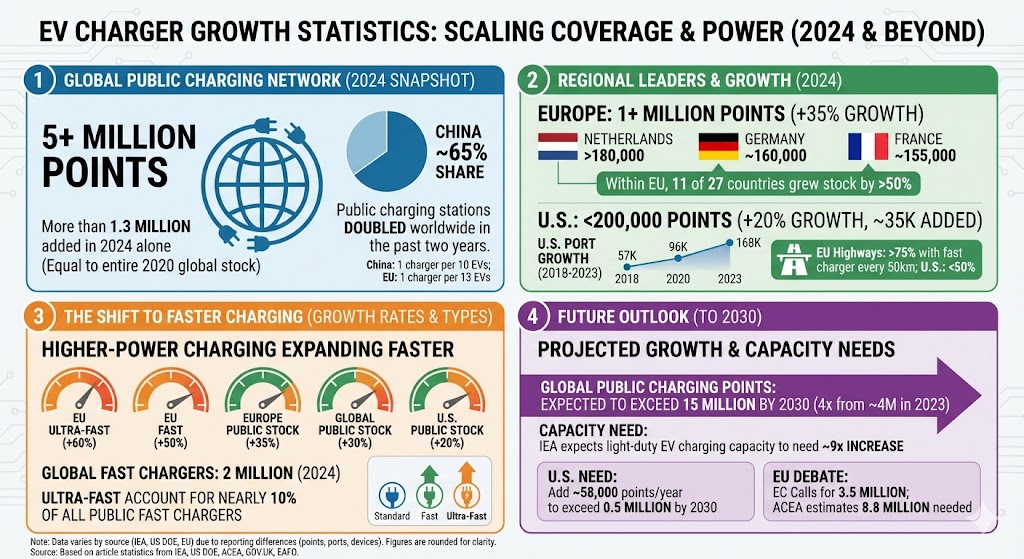
EV charger growth stayed strong in 2024, with the global public charging network crossing 5 million points and Europe moving past 1 million. Fast and ultra-fast deployment grew even faster than the overall network, showing that the market is scaling both coverage and charging power at the same time.
ev charger growth statistics
One important caveat is that source organizations do not always count exactly the same thing. The IEA reports public charging points, the U.S. Department of Energy reports charging ports, and some European sources report devices or points under different methodologies. Even with those differences, the direction of travel is clear: charger infrastructure is growing quickly, but not evenly across regions.
Key EV Charger Growth Statistics
Global public EV charging points exceeded 5 million in 2024.
More than 1.3 million public charging points were added globally in 2024.
That 2024 addition alone was roughly equal to the entire global public charger stock in 2020.
Public charging stations doubled worldwide in the past two years.
China now accounts for about 65% of global public charging points.
Europe’s public charging network grew by more than 35% in 2024 to just over 1 million points.
Within the EU, 11 of 27 countries increased public charger stock by more than 50% in 2024.
The Netherlands ended 2024 with more than 180,000 public charging points, the largest national network in Europe.
Germany followed with around 160,000 public charging points at the end of 2024.
France reached roughly 155,000 public charging points by the end of 2024.
The U.S. public charging network grew by 20% in 2024 to just under 200,000 public charging points.
The U.S. added about 35,000 public charging points in 2024.
Global fast chargers reached 2 million in 2024.
Ultra-fast chargers grew by about 50% in 2024 and now account for nearly 10% of all public fast chargers.
EU fast chargers excluding ultra-fast units reached 71,000 in 2024, up nearly 50% year over year.
EU ultra-fast chargers topped 77,000 in 2024 after growing by about 60% year over year.
China has more than 1 public charger for every 10 electric cars, while the EU averages 1 charger for every 13 electric cars.
More than three-quarters of European highways have a fast charger at least every 50 kilometres, versus less than half of U.S. highways.
The EU had 632,423 public charging points at the end of 2023 and installed about 153,000 new ones during that year.
Only around 13.5% of EU chargers were fast chargers at the end of 2023.
U.S. public EV charging ports increased from 57,386 in 2018 to 168,388 in 2023.
Global public charging points are expected to exceed 15 million by 2030 under stated policies, up fourfold from almost 4 million in 2023.
In the IEA stated-policies scenario, the U.S. would need to add about 58,000 public charging points per year to exceed 0.5 million by 2030.
The European Commission has called for 3.5 million charging points by 2030, while ACEA estimates 8.8 million may be needed.
Public EV Charging Network Size in 2024
The figures below use rounded 2024 values because several of the source figures are reported as more than, just over, or just under a round number.
Label
Bar
Value
Global public chargers
5,000,000
Europe
1,000,000
U.S.
200,000
Netherlands
180,000
Germany
160,000
France
155,000
Max = 5,000,000. Widths: Global public chargers 100.00%, Europe 20.00%, U.S. 4.00%, Netherlands 3.60%, Germany 3.20%, France 3.10%.
EV Charger Growth Rates in 2024
Growth rates show that higher-power charging expanded faster than the overall public charging network, especially in Europe.
Label
Bar
Value
Global public stock growth
30%
Europe public stock growth
35%
U.S. public stock growth
20%
EU fast chargers
50%
EU ultra-fast chargers
60%
Max = 60. Widths: Global public stock growth 50.00%, Europe public stock growth 58.33%, U.S. public stock growth 33.33%, EU fast chargers 83.33%, EU ultra-fast chargers 100.00%.
U.S. Public EV Charging Port Growth
The U.S. public charging network has expanded steadily for years, with charging ports rising by nearly three times between 2018 and 2023.
The headline growth numbers are strong, but the market is clearly splitting into two phases. The first phase is broad network coverage, where countries add more public chargers to reduce range anxiety and improve access. The second phase is power density, where the focus shifts toward faster chargers, highway coverage, and higher total charging capacity per vehicle.
That is why the fastest-growing segments are now public fast and ultra-fast chargers. Europe’s fast and ultra-fast growth rates in 2024 were well above overall network growth, and the IEA expects global charging capacity for light-duty EVs to need almost a ninefold increase by 2030. Put simply, the industry is no longer just trying to add plugs. It is trying to add enough high-power capacity to serve a much larger EV fleet efficiently.
EV Charger Growth Outlook
Global public charging points are expected to exceed 15 million by 2030 under stated policies.
That would represent roughly a fourfold increase from the almost 4 million public charging points operating in 2023.
The IEA expects global public charging capacity for light-duty EVs to need to grow by almost nine times by 2030.
In the U.S., annual public charger additions would need to average about 58,000 per year to move from 2024 levels to more than 0.5 million by 2030.
In the EU, the policy debate is no longer about whether more chargers are needed, but how many millions more are required and how quickly they can be installed.
Sources
International Energy Agency, Global EV Outlook 2025, Electric vehicle charging: https://www.iea.org/reports/global-ev-outlook-2025/electric-vehicle-charging
International Energy Agency, Global EV Outlook 2025, Executive summary: https://www.iea.org/reports/global-ev-outlook-2025/executive-summary
International Energy Agency, Global EV Outlook 2024, Outlook for electric vehicle charging infrastructure: https://www.iea.org/reports/global-ev-outlook-2024/outlook-for-electric-vehicle-charging-infrastructure
U.S. Department of Energy, Alternative Fuels Data Center, U.S. Public Electric Vehicle Charging Infrastructure: https://afdc.energy.gov/data/10972
ACEA, Charging ahead: accelerating the rollout of EU electric vehicle charging infrastructure: https://www.acea.auto/publication/automotive-insights-charging-ahead-accelerating-the-rollout-of-eu-electric-vehicle-charging-infrastructure/
GOV.UK, Electric vehicle charging infrastructure statistics collection: https://www.gov.uk/government/collections/electric-vehicle-charging-infrastructure-statistics
European Alternative Fuels Observatory, EU27 infrastructure overview: https://alternative-fuels-observatory.ec.europa.eu/transport-mode/road/european-union-eu27/infrastructure