Finding the right ramps for a low-clearance vehicle means balancing a gentle approach angle with dependable traction, usable lift height, and enough capacity for your car. The wrong ramp can scrape a bumper, slide under load, or leave too little working room.
We’ve gathered 10 low-profile car ramp options for oil changes, inspections, jack support, and routine home-garage maintenance. Use the guide below to compare their practical differences and choose a set that matches your vehicle and workspace.
Best 10 Car Ramps for Low Cars Picks for 2026
Best Low-Profile Pick
Black Widow 2.5-Inch Lift Ramps

- Gentle 9.05° loading angle
- 2.5-inch lift for basic service
- 10,000-pound pair GVW capacity
Best For: Low-clearance cars needing modest underbody access
Best Heavy-Duty Coverage

- 12,000-pound pair GVW capacity
- Wide 12-inch tread
- Rubber feet and non-skid surface
Best For: Mixed garages with cars, trucks, SUVs, or vans
Best Stable High-Lift Option

- 6.25-inch lift for greater access
- Ridged surface for tire traction
- Rubber base stops help prevent shifting
Best For: Routine maintenance needing more underbody clearance
Best Jack-Assist Design
2.6-Inch Low-Profile Car Ramps

- Designed for jack assistance only
- 9.3-inch width suits sport tires
- Compact 17.2-inch portable design
Best For: Low sports cars needing floor-jack clearance
Best Overall
Amazon Basics Low Profile Car Ramps
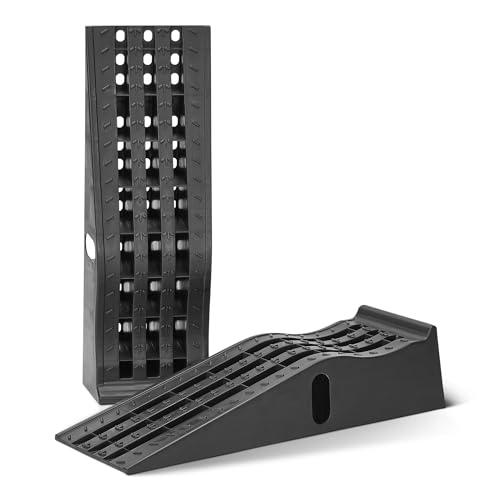
- 3,250-pound capacity per ramp
- Textured traction surface
- Rubber base stops and anti-slip design
Best For: Home-garage maintenance and oil changes
Premium Low-Car Pick
Race Ramps 67-Inch XT Service Ramp

- 10.8-degree gradual approach
- 10 inches of lift
- Floor-friendly high-density foam
Best For: Low-profile vehicles and tire service
Best Compact Option
NBTS265 Low Profile Jack Support Ramps

- 17.5-inch compact length
- 10-inch width for wider tires
- Only 5.3 pounds per pair
Best For: Low-chassis cars and space-limited garages
Best Overall Low-Profile Support

- 17-degree approach angle for low-chassis vehicles
- 2.44-inch lift with 12,300-pound pair capacity
- Wide PP design with anti-slip pads and mesh channels
Best For: Routine garage maintenance on low-profile cars
Best Wide-Footprint Pick
2.6-Inch Low-Chassis Car Ramps

- 10-inch width suits wider modified tires
- 2.6-inch lift with a 17-degree slope
- Honeycomb surface, drainage, and bottom non-slip pads
Best For: Sports cars, tuners, and low vehicles with wider tires
Best for High Vehicle Ratings

- 9-degree incline for low-chassis vehicles
- 20,000-pound stated GVW capacity
- Stackable PP construction with honeycomb traction
Best For: Low vehicles needing gradual access and compact storage
Best Low-Profile Pick – Black Widow 2.5-Inch Lift Ramps
For shoppers comparing car ramps for low cars, the Black Widow pair offers a gentle 9.05° loading angle and a modest 2.5-inch lift. Its compact plastic honeycomb construction is suited to oil changes and basic underbody access where low clearance is the main concern.
Best For: Low-clearance cars needing a small lift for oil changes and light service.
Pros:
- Gentle 9.05° approach angle accommodates many low vehicles.
- 2.5-inch lift can make oil-filter and underbody access easier.
- Pair supports up to 10,000 pounds GVW, or 5,000 pounds per axle.
- Honeycomb plastic design helps reduce moisture buildup.
Cons:
- The 2.5-inch lift is limited for repairs requiring substantial clearance.
- Vehicle clearance and gross weight must be confirmed before use.
- The slight tire stop does not replace careful positioning and a spotter.
This is a practical choice when minimizing approach angle matters more than maximizing lift height. Use the ramps with a spotter and verify fitment before driving onto them.
Best Heavy-Duty Coverage – Ironton Poly Car Ramp Set
The Ironton poly set is a strong option among car ramps for low cars when you also need broad vehicle compatibility. Its 35.5-inch length and 8.5-inch height provide a gradual approach, while the wide tread and high capacity suit cars, trucks, SUVs, and vans.
Best For: Drivers who want one ramp set for low-clearance vehicles and heavier trucks or SUVs.
Pros:
- 12,000-pound GVW capacity supports up to 6,000 pounds per ramp.
- Wide 12-inch tread accommodates a range of tire widths.
- Non-skid tread and rubber feet help limit tire and ground movement.
- High-impact poly construction is corrosion-resistant and weighs 20.6 pounds per pair.
Cons:
- At 8.5 inches tall, these are not the lowest-profile ramps in the group.
- The larger dimensions may take more storage space.
- Vehicle clearance and weight should still be checked before use.
Choose the Ironton set if versatility and capacity matter more than a minimal lift. The long approach, wide surface, and traction features make it useful for a mixed-vehicle garage.
Best Stable High-Lift Option – MaxxHaul 6.25-Inch Car Ramps
For car ramps for low cars that need more working room, the MaxxHaul 50515 provides a 6.25-inch lift from a 35.5-inch-long ramp. Its ridged surface and rubber base stops are designed to support a more controlled drive-on and drive-off experience.
Best For: Maintenance tasks such as oil changes, inspections, and repairs that benefit from higher underbody clearance.
Pros:
- 6.25-inch lift gives more underbody access than low-rise designs.
- Ridged surface adds traction during loading and unloading.
- Rubber stops on the base help reduce shifting.
- Heavy-duty plastic construction is designed for repeated use.
Cons:
- Capacity is 6,500 pounds per pair, despite the product title referencing 13,000 pounds GVW.
- The higher lift may require more vehicle-clearance checking than a 2.5-inch ramp.
- The supplied warranty is limited to 90 days.
This model balances a gradual 35.5-inch approach with a useful 6.25-inch lift. Confirm the vehicle’s gross weight and clearance before use, especially when selecting it for a low-front-end car.
Best Jack-Assist Design – 2.6-Inch Low-Profile Car Ramps
These compact ramps are designed specifically for car ramps for low cars, but they are jack supports rather than standalone ramps for crawling underneath a vehicle. The 17° slope, 9.3-inch width, and 2.6-inch lift help create room for sliding a standard hydraulic floor jack under low-chassis and sports cars.
Best For: Low sports cars needing floor-jack access and a compact, portable support aid.
Pros:
- Gentle-for-the-category 17° slope and extra-wide 9.3-inch platform suit wider sport tires.
- Six rubber pads help prevent sliding on garage floors.
- Short 17.2-inch design leaves more open space around the vehicle.
- Hollow mesh construction weighs 5.9 pounds and supports up to 13,000 pounds GVW.
Cons:
- These are for jack assistance only, not direct under-car crawling.
- The 2.6-inch lift provides limited clearance by itself.
- The short design may require careful positioning during loading.
This is the most specialized option in the group. It makes sense when your main obstacle is getting a floor jack beneath a low chassis, provided you follow the jack-assist-only limitation.
Best Overall – Amazon Basics Low Profile Car Ramps
For shoppers comparing car ramps for low cars, this Amazon Basics pair offers a practical balance of capacity, traction, and everyday garage usability. Each reinforced-plastic ramp is rated for 3,250 pounds and includes a textured surface, anti-slip technology, and rubber base stops for positioning on solid, level surfaces.
Best For: Home-garage oil changes, underbody access, and general maintenance when high per-ramp capacity is a priority.
Pros:
- Supports up to 3,250 pounds per ramp, or 6,500 pounds per pair.
- Textured traction surface helps provide confident vehicle placement.
- Rubber base stops and anti-slip features help limit unwanted movement.
- Relatively lightweight at 9.24 pounds per ramp.
Cons:
- Designed for solid, level surfaces rather than uneven ground.
- Plastic construction may not suit shoppers seeking foam or metal ramps.
With its substantial load rating and stability-focused design, this is a sensible general-purpose option for routine maintenance. Its 8.07-inch height and 35.51-inch length should be checked against your vehicle’s approach clearance before purchase.
Premium Low-Car Pick – Race Ramps 67-Inch XT Service Ramp
Among car ramps for low cars, the Race Ramps XT stands out for its long, gradual 10.8-degree approach and solid high-density foam construction. The 67-inch pair provides 10 inches of lift, accommodates tires and wheels up to 12 inches wide, and includes a raised lip to help prevent overrun.
Best For: Low-profile vehicles needing a gradual approach, tire service, and floor-friendly use in home garages or professional shops.
Pros:
- Long 67-inch design creates a gradual 10.8-degree approach.
- Provides 10 inches of lift for tire service and maintenance.
- Solid high-density foam with traction coating is designed not to scuff floors.
- Raised tire-stop lip and carrying strap support easier positioning and storage.
Cons:
- Each ramp is rated for 1,500 pounds, lower per ramp than some alternatives.
- At 67 inches long, the pair requires more storage space.
This is a specialized choice for drivers who value a gentle approach and substantial lift over compact storage. Confirm your vehicle’s tire width and available garage space before ordering.
Best Compact Option – NBTS265 Low Profile Jack Support Ramps
For car ramps for low cars that prioritize portability, this two-piece PP set measures 17.5 by 10 by 3.14 inches and weighs 5.3 pounds per pair. Its 17-degree slope is intended for low-chassis cars, sports cars, and tuners, while the honeycomb surface, curved profile, drainage design, and bottom pads support traction and positioning.
Best For: Compact garage storage, low-chassis vehicles, and using a ramp to create working room for a jack during repairs or inspections.
Pros:
- Compact dimensions make the pair easy to carry and store.
- 10-inch width helps accommodate wider modified tires.
- Honeycomb traction surface, curved design, and non-slip pads support stability.
- Provides a stated 2.6 inches of lift at the tire placement position.
Cons:
- The 2.6-inch tire-placement lift is lower than the lift offered by taller service ramps.
- The 17-degree slope may be less gradual than a longer low-profile ramp.
- Supplied specifications should be checked carefully against your vehicle and tire setup.
This lightweight design is convenient when storage space is limited and only modest lift is needed. Its compact format makes it particularly practical for low cars, but verify the ramp’s fit and stated capacity for your specific vehicle before use.
Best Overall Low-Profile Support – 2.44-Inch Wide Car Ramps
These car ramps for low cars combine a 17-degree approach angle with a 2.44-inch lift, helping create jack access beneath low-chassis vehicles without requiring a long ramp. Their wider footprint, anti-slip pads, and 6-ton pair capacity make them a practical option for garage maintenance and oil changes.
Best For: Low-profile cars needing compact, stable jack-support ramps for routine maintenance.
Pros:
- 17-inch length and 17-degree loading angle are designed to reduce bumper contact.
- Wider 9.5-inch footprint and anti-slip features help improve stability.
- Provides a 2.44-inch lift and supports up to 12,300 pounds per pair.
- Mesh channels help limit oil, water, and debris buildup.
Cons:
- The 2.44-inch lift may not provide enough clearance for every repair task.
- They are intended for tire support and may still require a suitable jack for additional lifting.
The compact design leaves more room for a jack and tools under the vehicle. Verify your car’s clearance, tire width, and required working height before use.
Best Wide-Footprint Pick – 2.6-Inch Low-Chassis Car Ramps
For shoppers comparing car ramps for low cars, this two-piece set offers a 17-degree slope and a 2.6-inch lift. The 10-inch width accommodates wider tires, while the honeycomb surface, curved tire stop, drainage design, and bottom pads support secure positioning during maintenance.
Best For: Low sports cars, tuners, and modified vehicles with wider tires.
Pros:
- 10-inch width helps reduce tire overhang on wider modified tires.
- 2.6-inch lift and 17-degree slope are designed for low-chassis access.
- Impact-resistant PP construction weighs about 5.3 pounds per pair.
- Honeycomb traction, drainage channels, curved ends, and bottom pads support stability.
Cons:
- The 2.6-inch lift may be insufficient for maintenance requiring greater elevation.
- The product notes recommend confirming vehicle ground clearance and maintenance needs before purchase.
This is a useful choice when tire width and ramp stability are priorities, though the modest lift is best suited to inspections, oil changes, and similar tasks rather than every undercar repair.
Best for High Vehicle Ratings – VEVOR 2.56-Inch Service Ramps
These VEVOR car ramps for low cars provide a 2.56-inch lift with a 9-degree incline, offering a relatively gradual approach for low-chassis vehicles and sports cars. The stackable PP ramps are rated for a 20,000-pound gross vehicle weight and include curved tire support plus a honeycombed traction surface.
Best For: Owners who want a lightweight, stackable ramp set with a high stated vehicle-weight rating.
Pros:
- 9-degree incline is designed to help reduce undercarriage scraping on low vehicles.
- Each ramp supports up to 5,000 pounds, with a stated 20,000-pound GVW capacity.
- Impact-resistant PP construction is weather- and corrosion-resistant according to the product notes.
- Honeycomb traction, drainage, and curved tire support help with positioning and stability.
Cons:
- The 2.56-inch lift may not create enough space for all service jobs.
- The listed dimensions are 27.4 inches long by 7.87 inches wide, so tire fit should be checked carefully.
- The product is recommended for use with a jack or jack stands, adding equipment requirements for some repairs.
Its gradual incline and high stated GVW rating make this set appealing for low-chassis access, while the stackable design helps with storage. Confirm tire compatibility and use appropriate supporting equipment for the intended task.
How We Picked the Best Car Ramps for Low Cars
We focused on ramps designed for low-clearance vehicles and evaluated the features that matter during real garage work: approach angle, stated weight capacity, lift height, tire-channel design, traction, portability, and intended use. The selection includes compact plastic ramps, heavy-duty steel-style options, foam service ramps, and products intended only for jack support or limited maintenance tasks.
Capacity claims should be treated as a starting point, not a substitute for checking the manufacturer’s instructions. Always confirm whether the rating applies per ramp, per axle, or to the complete set.
Quick Comparison
| Best For | What to Look For |
|---|---|
| Very low sports cars | Long, gradual approach ramps with minimal entry angle |
| Oil changes and inspections | Stable wheel channels, traction surfaces, and adequate lift height |
| Heavy vehicles | A clearly stated capacity with a substantial safety margin |
| Small garages | Lightweight, stackable, or easily stored construction |
| Jack support | Products specifically rated and labeled for that purpose |
Key Buying Factors for Car Ramps for Low Cars
Approach Angle and Lift Height
A low ramp is not automatically easy to use. The ramp’s length and slope determine whether the front lip clears your bumper. Long, gradual designs are usually better for sports cars and vehicles with aftermarket splitters, while shorter ramps may work well on cars with moderate clearance.
Capacity and Construction
Choose a set rated above your vehicle’s actual loaded axle weight. Account for passengers, cargo, tools, and uneven loading. Plastic ramps can be convenient and corrosion-resistant, while heavy-duty designs may offer more rigidity. Never exceed the stated rating or combine ramps in a way the manufacturer does not approve.
Traction and Wheel Retention
Look for textured or grooved surfaces, raised side rails, and a defined tire stop. Use the ramps on a clean, level, hard surface. Chock the wheels that remain on the ground, engage the parking brake when appropriate, and drive up slowly with a spotter if visibility is limited.
Stability and Intended Use
Some ramps are meant for driving onto, while others provide jack support only. Check whether the product is suitable for your vehicle type and maintenance task. Ramps are not a replacement for properly rated jack stands when the manufacturer requires them, and you should never work beneath a vehicle supported only by a jack.
Who Should Buy Which Car Ramps for Low Cars?
Choose a long, gradual ramp if your priority is protecting a very low front bumper. For routine oil changes in a home garage, prioritize a stable channel, traction texture, and enough lift to reach the drain plug comfortably. Heavy trucks, SUVs, and loaded vehicles should favor a high-capacity set with a generous safety margin.
If storage space and portability matter most, a lightweight low-profile pair may be the practical choice. Buyers seeking maximum rigidity should consider a heavier construction. Before purchasing any of these Car Ramps for Low Cars, measure your vehicle’s lowest clearance, check the ramp’s entry height and dimensions, and verify the capacity and intended use in the current product documentation.