The best natural gas garage heaters can make a cold workshop or oversized garage comfortable without relying on portable electric heaters. The right choice depends on your space, insulation, ventilation, and how quickly you need heat.
Our 2026 roundup includes forced-air, radiant, vent-free, and direct-vent models across multiple BTU ranges, helping you compare practical options for occasional projects or daily shop use.
Best 10 Natural Gas Garage Heaters Picks for 2026
High-Capacity Pick
80,000 BTU Forced-Air Unit Heater
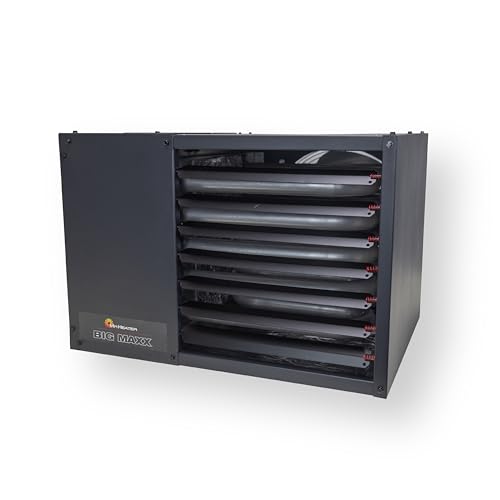
- 80,000 BTUs for up to 2,667 square feet
- Ceiling-mounted, low-profile design
- Safety shut-offs included
Best For: Large garages, barns, and workshops
Power-Outage Pick
25,000 BTU Radiant Garage Heater

- Covers approximately 500 to 600 square feet
- Needs no electricity to operate
- Includes a thermostat
Best For: Small garages and low-profile buildings
Mid-Size Garage Pick

- Heats up to 1,667 square feet
- Suitable for approximately a three-car garage
- Supports 24-volt and Wi-Fi thermostats
Best For: Medium garages and workshops
Quiet Commercial-Grade Pick
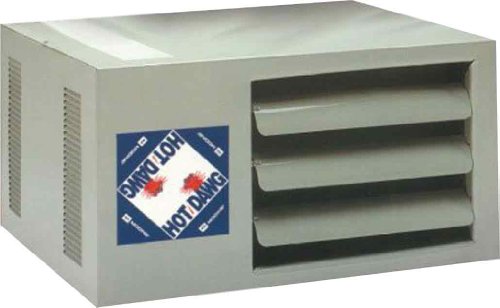
- 45,000 BTUs for approximately 700 square feet
- Quiet, low-profile operation
- Power exhaust supports side-wall or roof venting
Best For: Smaller residential, commercial, or industrial garages
Best High-Output Pick
Mr. Heater 125,000 BTU Forced-Air Unit Heater
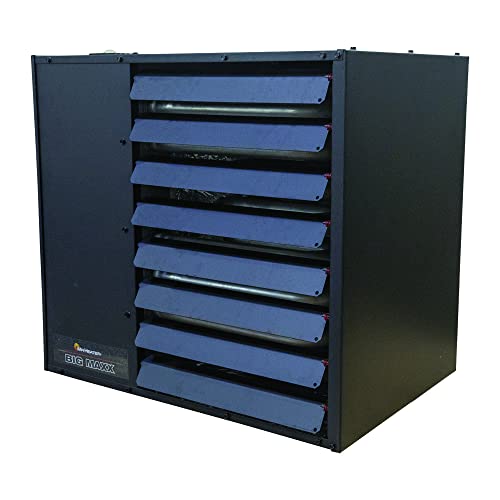
- 125,000 BTU forced-air output
- Natural gas or propane flexibility
- Ceiling-mount, thermostat-compatible design
Best For: Large garages and workspaces needing high-output heat
Best Compact Vent-Free Option
Mr. Heater 30,000 BTU Blue Flame Heater

- 30,000 BTU output for up to 1,000 square feet
- No electricity or outdoor venting required
- Adjustable thermostat and low-oxygen shut-off
Best For: Smaller garages needing simple supplemental heat
Best Shop-Grade Balance
Reznor 60K BTU Natural Gas Garage Heater

- 60,000 BTU output with 83% efficiency
- Ceiling- or wall-mount configuration
- Durable components for garage and shop use
Best For: Medium-sized garages and workshops with required venting
Best Radiant Coverage
Mr. Heater 30,000 BTU Natural Gas Heater

- 30,000 BTU output for up to 1,000 square feet
- Adjustable thermostat and battery ignition
- No electricity or outdoor venting required
Best For: Larger indoor spaces needing vent-free radiant heat
Best Flexible Placement
ProCom 30,000 BTU Infrared Plaque Heater

- Heats up to a stated 1,400 square feet
- Wall mount and base feet included
- Three thermostat settings with oxygen-depletion sensor
Best For: Flexible floor or wall placement without electricity
Best Vented Wall Mount
Comfort Glow 17,000 BTU Natural Gas Heater

- Direct-vent 17,000 BTU design for up to 500 square feet
- Includes professional vent kit
- Electronic ignition and thermostatic control
Best For: Smaller spaces needing permanent direct-vent heat
High-Capacity Pick – 80,000 BTU Forced-Air Unit Heater
For large garages, barns, and workshops, this natural gas garage heater delivers 80,000 BTUs of forced-air heat across up to 2,667 square feet. Its ceiling-mounted design helps preserve floor space, though installation requires a 10-foot minimum ceiling and 8 feet of clearance from the heater base to the floor.
Best For: Large workspaces that need high-output, ceiling-mounted heating.
Pros:
- Heats up to 2,667 square feet with 80,000 BTUs.
- Works with standard 24-volt or Wi-Fi-enabled thermostats, sold separately.
- Includes high-temperature and gas flame-safety shut-offs.
- Comes with ceiling-mount angle brackets and an NG-to-LP conversion kit.
Cons:
- Requires a 10-foot minimum ceiling and 8 feet of floor clearance.
- Thermostat is not included.
- Its 78.2-pound size may require substantial installation support.
This is the strongest choice here for broad coverage and high heat output, provided your garage meets the clearance requirements and has suitable ceiling-mount access.
Power-Outage Pick – 25,000 BTU Radiant Garage Heater
This natural gas garage heater uses radiant heat to warm people and objects directly, making it a practical option for smaller garages and low-profile buildings. The 25,000-BTU unit covers approximately 500 to 600 square feet and requires no electricity, so it can continue heating during power outages.
Best For: Smaller garages, workshops, and spaces needing quiet, electricity-free heat.
Pros:
- Radiant heat directly warms people and objects.
- Requires no electricity and can heat during power outages.
- Designed for low-profile buildings with 7- to 8-foot ceilings.
- Includes a thermostat and has no moving parts to service.
Cons:
- Covers only about 500 to 600 square feet.
- Thermostat wiring is not included.
- Not intended for sleeping quarters, mobile homes, or recreational vehicles.
Its modest coverage and radiant heating method make it especially suitable for a smaller garage where quiet operation and backup heat matter more than whole-building airflow.
Mid-Size Garage Pick – 50,000 BTU Forced-Air Heater
For a mid-size garage, this 50,000-BTU natural gas garage heater provides forced-air heat for up to 1,667 square feet, or approximately a three-car garage. It mounts to the ceiling to keep the work area open and supports standard 24-volt and newer Wi-Fi-enabled thermostats, which are sold separately.
Best For: Three-car garages and medium-sized workshops with adequate ceiling height.
Pros:
- Heats up to 1,667 square feet with 50,000 BTUs.
- Ceiling-mounted design helps save floor space.
- Compatible with standard 24-volt and Wi-Fi-enabled thermostats.
- Includes high-temperature and gas flame-safety shut-offs.
Cons:
- Requires a 10-foot minimum ceiling and 8 feet of clearance below the heater.
- Thermostat is sold separately.
- Coverage is lower than the 80,000-BTU model in this roundup.
This model balances useful three-car-garage coverage with a space-saving ceiling installation, making it a sensible middle-ground option when the larger unit would be excessive.
Quiet Commercial-Grade Pick – 45,000 BTU Hot Dawg Heater
Modine HD45AS0111Natural Gas Hot Dawg Garage Heater 45,000 BTU with 80-Percent Efficiency Grey
Check Price On AmazonThe Modine Hot Dawg is a 45,000-BTU natural gas garage heater designed for quiet forced-air operation and approximately 700 square feet of coverage. Its low-profile cabinet mounts overhead, while the power exhaust supports side-wall or roof venting with small-diameter vent pipe.
Best For: Residential, commercial, or industrial garages needing quiet overhead heating and flexible venting.
Pros:
- Quiet operation for a more comfortable workspace.
- Certified for residential, commercial, and industrial use.
- Low-profile design with a neutral gray finish.
- Power exhaust simplifies side-wall or roof venting.
Cons:
- Listed coverage is approximately 700 square feet.
- Requires gas and electrical connections for its 115-volt operation.
- Venting and field wiring are part of the installation process.
This is a practical choice when quiet performance, compact overhead mounting, and venting flexibility are priorities, particularly in a smaller garage or mixed-use workspace.
Best High-Output Pick – Mr. Heater 125,000 BTU Forced-Air Unit Heater
For large garages, barns, and workshops, this Mr. Heater unit delivers 125,000 BTU of forced-air heat and supports either natural gas or propane. Its ceiling-mount design helps preserve floor space, while thermostat compatibility allows more flexible temperature control.
Best For: Large garages and workspaces needing high-output, ceiling-mounted heat.
Pros:
- Heats areas up to 4,167 square feet according to the supplied product information.
- Supports natural gas or propane operation.
- Ceiling-mount design saves valuable floor space.
- Compatible with standard 24-volt and Wi-Fi-enabled thermostats, sold separately.
Cons:
- At 109.1 pounds, it is a substantial installation.
- Thermostat and some conversion components may require separate purchase.
- Its high heat output may be excessive for smaller garages.
This is the strongest fit of the three for large, drafty work areas where rapid forced-air heating and flexible fuel options matter. Verify installation requirements and sizing before choosing it for a smaller space.
Best Compact Vent-Free Option – Mr. Heater 30,000 BTU Blue Flame Heater
This 30,000 BTU Mr. Heater is a practical natural gas garage heater for smaller spaces where simple installation and quiet, vent-free operation are priorities. It heats up to 1,000 square feet, includes an adjustable thermostat, and does not require electricity or outdoor venting.
Best For: Smaller garages or indoor spaces needing straightforward supplemental heat.
Pros:
- Provides up to 30,000 BTU per hour for spaces up to 1,000 square feet.
- Requires no electricity and no outdoor venting.
- Includes battery-operated electronic ignition and an adjustable thermostat.
- Built-in low-oxygen safety shut-off supports indoor use.
Cons:
- Its 1,000-square-foot coverage is limited compared with larger unit heaters.
- A blower fan kit is sold separately.
- Wall mounting may offer less placement flexibility than a ceiling-mounted garage heater.
Choose this model when your garage is relatively compact and you value uncomplicated, electricity-free operation. Its lower output makes it less suitable for large workshops or heavily insulated spaces requiring whole-area heating.
Best Shop-Grade Balance – Reznor 60K BTU Natural Gas Garage Heater
The Reznor UDXC-60 is a 60,000 BTU natural gas garage heater designed for garages, workshops, and other indoor commercial or industrial spaces. Its forced-air design, 83% thermal efficiency rating, and ceiling- or wall-mount compatibility provide a balanced option for medium-sized work areas.
Best For: Medium-sized garages and workshops that need a durable, professionally installed unit heater.
Pros:
- Delivers 60,000 BTU of forced-air heating for listed coverage of 1,200 to 2,000 square feet.
- Offers an 83% thermal efficiency rating.
- Can be configured for ceiling or wall mounting with the appropriate bracket.
- Includes a heat exchanger, combustion controls, built-in disconnect, and status-indicating LED.
Cons:
- Mounting hardware is sold separately.
- The listing includes the main unit only.
- Venting is required, with compatible vent options depending on installation direction.
This model sits between compact vent-free heaters and oversized high-output units, making it a strong fit for medium workspaces. Account for separate mounting hardware and required venting when comparing total installation costs.
Best Radiant Coverage – Mr. Heater 30,000 BTU Natural Gas Heater
For shoppers comparing natural gas garage heaters, this Mr. Heater model combines 30,000 BTU of radiant heat with coverage rated up to 1,000 square feet. Its vent-free design, adjustable thermostat, and battery-operated ignition can be useful where electrical power or outdoor venting is unavailable.
Best For: Larger indoor spaces needing radiant natural-gas heat without electricity or outdoor venting.
Pros:
- 30,000 BTU output with coverage up to 1,000 square feet.
- Adjustable built-in thermostat helps regulate temperature.
- Battery-operated electronic ignition and no electricity required for operation.
- Includes low-oxygen safety shut-off and wall-mounting hardware.
Cons:
- Blower fan kit is sold separately.
- Vent-free installation may not suit spaces requiring vented combustion.
- Heater is relatively large at 23.75 inches deep by 11.25 inches wide by 27 inches high.
This is a strong option when broad coverage and off-grid convenience matter most. Confirm that a vent-free natural-gas heater is appropriate for your installation before buying.
Best Flexible Placement – ProCom 30,000 BTU Infrared Plaque Heater
This ProCom infrared model is a flexible choice among natural gas garage heaters, offering 30,000 BTU and claimed coverage up to 1,400 square feet. It can be wall-mounted or used on the floor with the included base feet, while three thermostat settings provide basic heat adjustment.
Best For: Buyers who want portable placement options and thermostat control without relying on electricity.
Pros:
- 30,000 BTU infrared heat with stated coverage up to 1,400 square feet.
- Includes both wall-mount hardware and base feet.
- High, medium, and low thermostat control offers adjustable operation.
- Push-button ignition and built-in oxygen depletion safety sensor.
Cons:
- Ventless design may not be suitable for every installation.
- Push-button ignition is less automated than electronic ignition.
- Its 26.63-inch width may require careful placement planning.
The included mounting choices make this heater especially adaptable for rooms where layout or installation needs may change. Its natural-gas, no-electricity operation also supports use during power outages.
Best Vented Wall Mount – Comfort Glow 17,000 BTU Natural Gas Heater
For a more permanent installation, this Comfort Glow direct-vent model provides 17,000 BTU for spaces rated up to 500 square feet. It mounts on the wall, vents directly through it, and includes a professional vent kit, making it a practical consideration for smaller garages or other approved indoor areas.
Best For: Smaller spaces where a wall-mounted, direct-vent natural-gas heater is preferred.
Pros:
- Direct-vent design avoids the need for a chimney.
- Includes vent pipe, air-intake pipe, vent cap, flashing, and related hardware.
- Thermostatic heat control and electronic ignition simplify operation.
- Sealed burn system, safety pilot, and pressure regulator support safer operation.
Cons:
- 17,000 BTU output and approximately 500-square-foot coverage are lower than the other listed models.
- Requires wall penetration and installation through walls 4.5 to 10 inches thick.
- Wall-mounted design offers less placement flexibility than a floor-standing heater.
This model trades maximum heating capacity for a sealed, space-saving installation. Its included vent kit and no-electricity operation are useful, but verify wall compatibility and local installation requirements first.
How We Picked the Best Natural Gas Garage Heaters
We evaluated these Natural Gas Garage Heaters by heating capacity, heater type, installation requirements, operating efficiency, controls, and suitability for different workspace sizes. We also considered whether each design is intended for overhead installation, wall mounting, or portable placement. Because garages vary widely in insulation and air leakage, BTU rating was treated as a starting point rather than the only measure of performance.
Safety and installation requirements were equally important. Direct-vent and forced-air units generally require venting or professional installation, while vent-free models have different clearance and ventilation considerations. Always verify local building codes and follow the manufacturer’s installation instructions.
Quick Comparison
| Heater type | Best suited for | Main advantage | Important consideration |
|---|---|---|---|
| Forced-air unit | Large garages and workshops | Fast, broad heat distribution | Usually needs venting, wiring, and installation planning |
| Radiant overhead | Work areas and occupied zones | Directly warms people and surfaces | Heat coverage depends on placement and line of sight |
| Vent-free blue flame or infrared | Smaller spaces and supplemental heat | Flexible installation and high efficiency | Requires careful attention to ventilation and clearances |
| Direct-vent wall heater | Enclosed rooms or finished workspaces | Sealed combustion and controlled exhaust | Needs an appropriate exterior vent location |
Key Buying Factors for Natural Gas Garage Heaters
BTU Output and Garage Size
Choose output based on square footage, ceiling height, insulation, climate, and how often the garage door opens. A poorly insulated detached garage may require substantially more capacity than a finished, attached space. Oversizing can cause short cycling, while undersizing may leave the heater running constantly without reaching a comfortable temperature.
Venting and Combustion Air
Forced-air and direct-vent heaters typically need specific venting arrangements and adequate combustion air. Vent-free heaters do not use a flue, but they still require the clearances and ventilation specified by the manufacturer. Never install a fuel-burning heater in a way that conflicts with local code or the product manual.
Heat Distribution and Noise
Forced-air models heat quickly and distribute warmth across a large area, but their fans produce operating noise. Radiant heaters are quieter and can feel warm quickly near a workbench, although they may not heat every corner evenly.
Controls, Fuel, and Installation
Look for thermostat control, adjustable output, ignition features, and compatibility with your existing natural-gas supply. Confirm gas-line sizing, electrical requirements, mounting hardware, and professional installation needs before buying.
Who Should Buy Which Natural Gas Garage Heaters?
Choose a forced-air unit for a large, drafty garage or workshop where rapid whole-space heating matters. A radiant overhead model is a strong fit when you want quiet, targeted warmth around work areas. Vent-free blue-flame and infrared heaters suit buyers seeking simpler installation or supplemental heat, provided the space meets all safety requirements. A direct-vent wall heater is often the better choice for a more finished, enclosed workspace where sealed combustion is a priority.